



Why the Bodily Resurrection of Jesus Matters for Christian Formation
April 15, 2025 (Updated April 7, 2026)
The bodily resurrection of Jesus Christ is not merely the climax of the gospel narrative. It is the structural center of Christianity.
Paul leaves no room for ambiguity: “If Christ has not been raised, our preaching is useless and so is your faith” (1 Corinthians 15:14, NIV). If Christ was not truly raised in flesh and bone, Christian faith collapses. Sin remains undefeated. Death retains its authority. Hope becomes sentiment.
Most Christian schools affirm this doctrinally.
The more pressing question is formation-level:
Is the bodily resurrection functioning as the interpretive center of your school’s worldview—or is it assumed, seasonal, or quietly abstracted?
The Resurrection as Historical Reality
The New Testament does not present the resurrection as metaphor. It presents it as history.
Jesus was publicly crucified, verifiably buried, and raised bodily. He invited His disciples to examine Him: “A ghost does not have flesh and bones, as you see I have” (Luke 24:39). Thomas touched His wounds (John 20:27). Paul referenced eyewitnesses, including more than five hundred at one time (1 Corinthians 15:3–6).
The physicality matters.
If the resurrection were symbolic, Christianity would drift toward abstraction. But a bodily resurrection anchors faith in space, time, and material reality.
When foundational beliefs thin, ethical reasoning eventually thins as well.
Students rarely abandon conviction overnight. Drift begins when central claims become negotiable or assumed rather than articulated. Leaders must periodically examine whether core doctrines are actively shaping belief or simply sitting in the background.
The Resurrection and the Behavior Dimension
Paul presses further: “If Christ has not been raised, your faith is futile; you are still in your sins” (1 Corinthians 15:17).
The resurrection validates the cross. It confirms that sin was decisively addressed. Obedience, therefore, is not moral performance. It is embodied gratitude rooted in accomplished redemption.
This reframes discipline in a Christian school. We are not merely managing conduct; we are forming redeemed image-bearers whose bodies matter eternally.
Outward compliance can coexist with inward disengagement.
The resurrection guards against both legalism and hollow participation. If Christ rose bodily, repentance is rational. Integrity is meaningful. Sexual ethics are not arbitrary constraints. Academic honesty is not merely procedural.
Affection must be grounded as well. Emotional warmth detached from doctrinal clarity will not sustain long-term faithfulness.
Students are not invited to admire a moral teacher. They are called to follow a living Lord.
The Resurrection and the Heart Orientation Dimension
The resurrection most visibly reshapes the attitude dimension of worldview.
Paul concludes 1 Corinthians 15 with this charge: “Stand firm… because you know that your labor in the Lord is not in vain” (v. 58).
If Christ is raised:
- Suffering is not ultimate.
- Death does not have the final word.
- Faithfulness is not wasted.
Biblical hope is not vague optimism. It is orientation grounded in objective truth.
When students face failure, hostility, or loss, what sustains them? A symbolic resurrection cannot bear that weight. A historical, bodily resurrection can.
Without it, resilience must be manufactured. With it, perseverance flows from promise.
The Resurrection and Formation Drift
When students disengage from church or Christian practice, the presenting reasons vary. Beneath many departures lies thin theological grounding.
If Christianity is reduced to morality or belonging, it cannot withstand sustained intellectual or cultural pressure. When it is rooted in a risen Savior, endurance becomes intelligible.
The resurrection is not merely something to defend apologetically. It is something to integrate formation-wise.
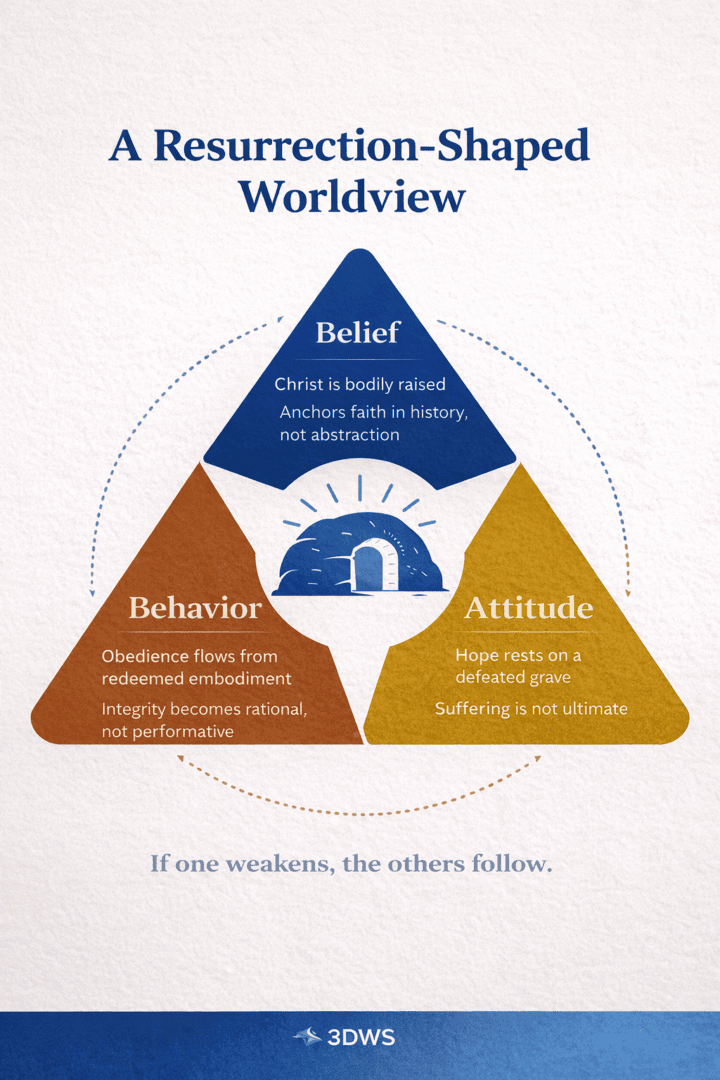
Belief: Christ is bodily raised.
Behavior: Obedience flows from redeemed embodiment.
Heart Attitude: Hope rests on a defeated grave.
If any one dimension weakens, the others follow. Think of it like this:
A Resurrection-Shaped Culture
The resurrection shapes more than theology class.
- It shapes how we teach history—because history is moving toward restoration.
- It shapes how we teach science—because matter is redeemable.
- It shapes how we counsel students—because despair is not final.
Christian education without a living resurrection center will slowly default to moralism.
Christian education grounded in resurrection builds durable hope.
If you want to examine how belief, behavior, and heart orientation are functioning in your school—not only in stated doctrine but in lived formation—download 10 Questions Every Christian School Leader Should Be Asking About Student Worldview and work through it with your leadership team.
May we boldly proclaim the truth of the risen Christ, allowing His victory to shape our faith, our teaching, and our engagement with the world.
Key Takeaways
- The bodily resurrection is the structural center of Christian faith—not a peripheral doctrine—and must function as such in formation.
- When the resurrection is assumed or abstracted, belief thins, and ethical reasoning loses its grounding.
- The resurrection integrates all three dimensions of worldview:
Belief is anchored in historical reality
Behavior flows from redeemed embodiment
Attitude is sustained by durable hope - If the resurrection is not actively shaping your school’s culture, Christian education will drift toward moralism rather than formation.